Meet the author - Laura Broadbent

It’s a big week at Prosperity Education as we simultaneously launch a book and app - English Master Key Word Formation, available on Google Play, iTunes and Amazon.
Here we catch up with the author Laura Broadbent and talk about her career and her thoughts on the Cambridge exams.
“Always read. Reading will improve your language level in all parts of the exam. I’d say it’s much better than trying to learn lists of words, and more fun!”
How long have you worked in English-language education, and why did you choose this as a career?
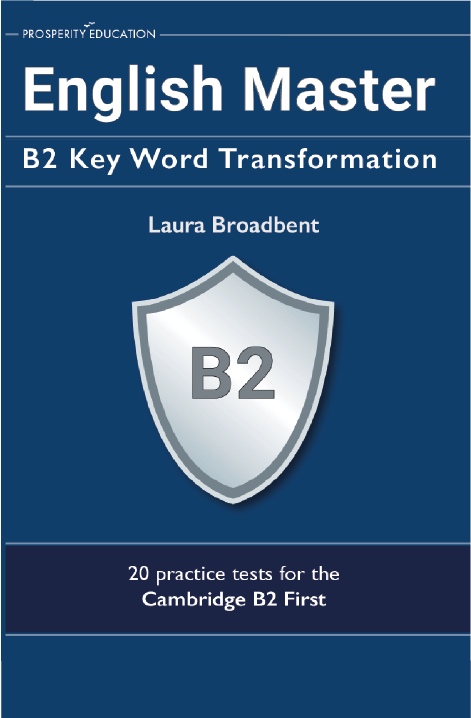
This is a digital download.
You can also buy in print…
Directly from Prosperity Education | From Amazon | From Egis (Poland)
5-star Amazon reviews
"I recommend it to whoever in taking the FCE exam." Reinaldo in Brazil
"Very useful for really knowing what to revise and what kinds of exercises this type of exam is based on." Tiger007fr in France
"I've to say that the material is very useful and well organised. The structure of the exercises is quite similar to those of the B2 exam. However, the level of difficulty is slightly higher than the usual. Great choice!" My B2 Journey in Italy
"Very good book for practicing the First Certificate questions." Bianca in Italy
In secondary school, I volunteered to help groups of primary students with reading and writing in English classes and taught English in a school in Malaysia before studying English at university. So you could say my career following my formal education was already written in stone! I went on to teach English in Italy, France and then Madrid. After several years, I was lucky enough to combine my love of writing and education by translating school books from Spanish to English for Anaya. Since then I've written content for various publishers and never looked back.
Which parts of the Cambridge exams do you think students struggle with the most?
I think students usually find the Use of English exam the most difficult, and particularly part 4, simply because there aren’t many opportunities to practise it.
It can also be intimidating because each question is just one sentence long, which can seem quite scary as you don’t have the cushion of context and other words you might understand.
I’d also say the Reading section is difficult because there’s a lot of text to read and understand in little time.
How would you describe the difference in language mastery between B2 and C1?
I’d say there’s quite a big jump from B2 to C1. Imagine sitting in a bar with a group of people: If you have B2 level, you’ll need the bar to be quiet, no music and just two other people speaking to be able to follow the conversation and join in; if you have C1 level, you can join in with the conversation with four or more people, music and other people chatting in the bar. Which one is a realistic situation? The latter. I’d say that the language in C1 is the language people use outside of the classroom that includes phrasal verbs, grammatical structures to talk about all conditional situations and layered tenses... It’s a jump, but it’s really worth it if you want to use English confidently.
Is there any one, last-minute technique or piece of advice that you would give a student about to sit their Cambridge exam?
If you don’t know the answer to a question, leave it and complete the questions you know. Then go back and try the questions you’re not sure about.
What can seem impossible the first time, can be obvious the second time. Trust yourself as well. Take deep breaths to help yourself think clearly.
Apart from that, read! Always read. Reading will improve your language level in all parts of the exam. I’d say it’s much better than trying to learn lists of words, and more fun!
How did you become an author with Prosperity Education?
I went to a Society of Authors conference in London and Tom O’Reilly gave a talk about Prosperity Education and their work. My ears first pricked up when he mentioned they were based in the UK and Madrid, which reflects my own background in ELT. Not only are they creating products for the modern industry, such as apps, but Tom also demonstrated their meticulous research and preparation. His talk was practical, logical and inspirational. I thought this is exactly the environment I want to be working in and I went straight to talk to him afterwards.
Have you ever written content for an app before?
This has been my first app but I’ve written a lot of digital content before. Some of this includes podcasts and online games and quizzes, which are actually available in app form. I’ve also created ELT videos for learners to use either alongside course materials or as stand-alone resources. I love writing content for these different mediums because they allow learners to watch, listen, touch the screen, write and play, so there’s huge scope for creativity and fun. I’m really keen to work on more apps because that’s the way many users are learning now. They're convenient, easy to dip in and out of and have the potential to be versatile.
What would you say were the challenges involved in writing content for the English Master: B2 Key Word Transformation app?
When you read the Key Word Transformation questions in the exam, they seem quite simple but, like any well-written book, that’s because a lot of thought has gone into writing them. When writing the questions, I had to create a clear context and make the questions sound authentic, which is tricky when you’ve got to fit in a specific language point as well. Also, making sure both sentences have exactly the same meaning is hard! So many similar words and expressions carry slightly different meanings which really limits the language you can put into the original sentence. I was very fortunate that a Cambridge examiner reviewed my questions and gave me really supportive and constructive feedback. This was vital to writing high-quality questions that mirrored those in the exams.
What do you think are the three most-important aspects of a study resource, from a student’s perspective?
A good study resource should include visuals, sound and be interactive so that all learners can use it productively.
Having feedback and opportunity to practise wrong answers. For example, apps that remember incorrect answers and repeat those questions so the learner can learn from his/her mistakes.
Study resources must be fun so that you enjoy using them and the learning experience. This could be in the format of games, videos or interactive texts.
I see that you have won an ELTon award - what is that, and how did you win one?
I created some of the videos for the Ready to Run series by Digital Learning Associates, which went on to win the ELTon award for Innovation in Learner Resources this year (2019). The videos take topics from popular vloggers, broadcasters and human stories around the world and create graded stories with full lesson plans, activities and transcripts. I edited video content, wrote video narratives and the accompanying lesson plans and activities. I loved working on the videos because I could do lots of different things, and I found some fascinating stories. It was a great experience working on materials for the new generation of learners, and the award was the cherry on the top!
What are you currently working on and what will you be doing next?
I’m delighted to be working on a book of B2 Reading practice tests with Prosperity Education. As I mentioned, the Reading section is really difficult for learners because of the volume of text candidates have to read. This book will give students a lot of opportunity to practise this part of the exam, but also all other parts of the exam. By reading, you improve your vocabulary, grammar and speed in processing English, so it’s a no-brainer!
Apart from that, I’m also writing a series of graded readers and three series of primary text books over the next few months. I’m also studying materials for SEN students because I really want to create content that’s accessible to all types of learners.