
Cambridge B1 Preliminary Writing
Margaret Cooze holds an MA in Applied Linguistics and an MSc in English Language Teaching Management, and has worked in senior roles at Cambridge English Language Assessment and Cambridge Assessment International Education. She is the author of several ELT resources published by Cambridge University Press, and is the lead author of our popular ‘Cambridge Masterclass’ series:


In this article, Margaret explains the format, structure, task types and marking criteria of the Cambridge B1 Preliminary Writing examination.
The Cambridge B1 Preliminary exam
B1 Preliminary is one of the exams in the series provided by Cambridge Assessment – part of the University of Cambridge. It is the second in the range of tests they provide in General English:
A2 Key (KET)
B1 Preliminary (PET)
B2 First (FCE)
C1 Advanced (CAE)
C2 Proficiency (CPE)
The references next to each test refer to the CEFR Level (Common European Framework of Reference), and show the language level of each test. For CEFR B1 Writing, you will be able to:
communicate your ideas in writing on everyday topics
write clearly and in some detail
explain your ideas about a situation
recognise the reader of texts and use a suitable register
show different grammatical structures
show suitable vocabulary for the tasks set
recognise the functional language needed in tasks.
How does the test work?
You can take the B1 Preliminary exam on a computer or on paper. The content is the same for both forms of the test. The B1 Preliminary Writing paper gives you the opportunity to show your language skills. The topics of tasks are chosen so that they are relevant to the typical student taking this exam, so you should find that you have enough ideas to write about. Each question will guide you by identifying the context, the purpose for writing and the target reader. It is important to remember that you aren’t being tested on the subject content of the tasks. So, if the topic of the Part 1 question, for example, is education, you aren’t expected to be an expert about this topic. The test format is:
Time allowed: 45 minutes
Number of parts: 2
Number of questions:
Part 1: one compulsory question
Part 2: one optional question from a choice of two
Task types: essay, article, story
Length: each answer should be about 100 words long
Task type 1: Email
Part 1 (Question 1) of the Writing paper is always an email written in reply to an email you have been sent. There will be four ‘notes’ on the side of the email that will guide you in writing your email in reply.
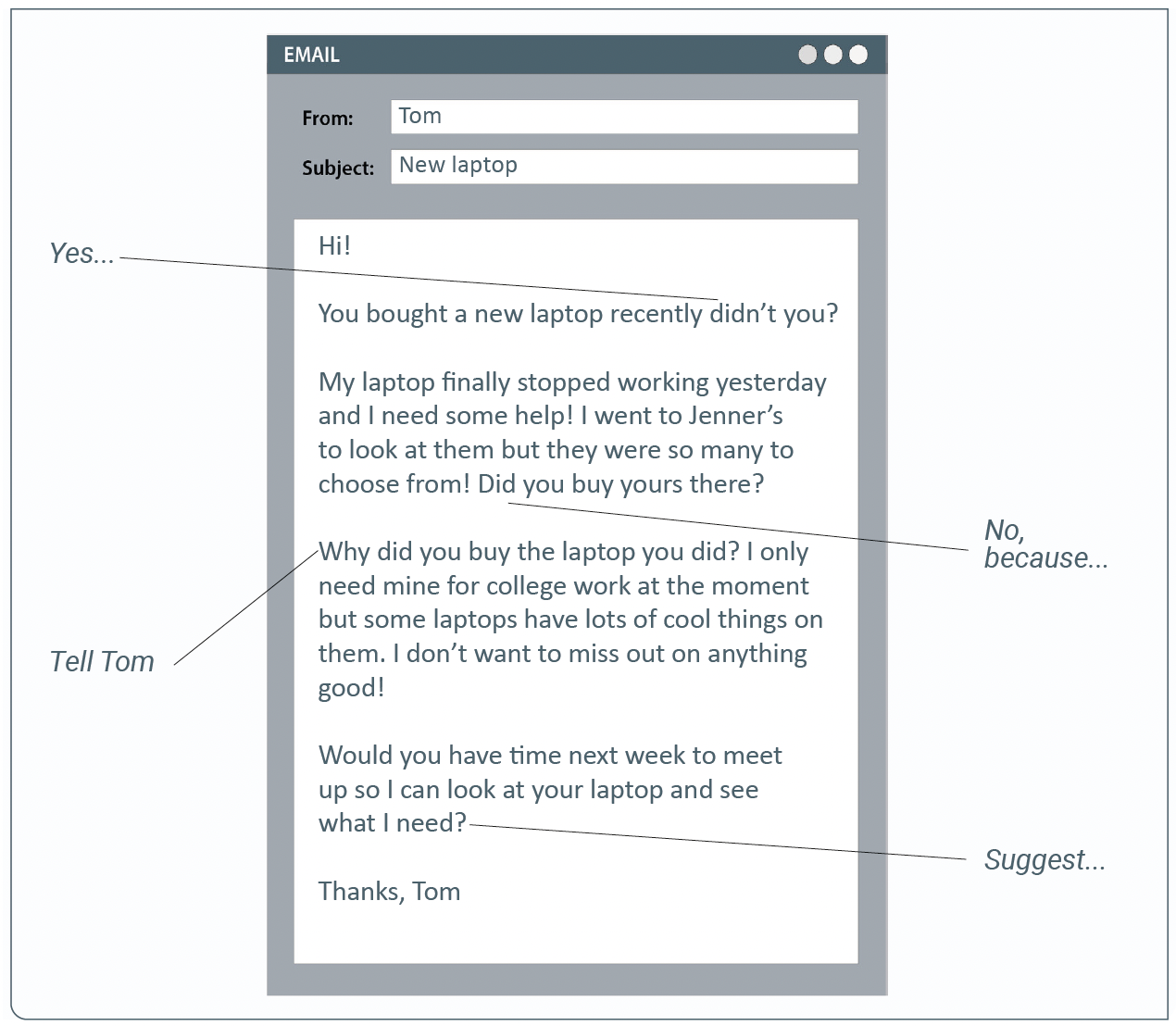
You must include information for each of the notes provided, and this will be made clear in the question. For example:

It’s a good idea to tick these off on the question paper as you include them to make sure that you don’t miss anything. You can get used to thinking about these notes by recognising what you are expected to do.
Look at these examples:

As you can see, the same content in the email might have different notes, so it’s very important that you think about what the notes are telling you to do.
Here are some more examples of notes:

An email can be organised in different ways, and some of the notes can be covered quickly while others will need more words to reply. Emails to a friend may be less formal, and emails to a teacher should be semi-formal and polite. Remember, you don’t have to tell the truth! The examiners won’t know, so if you don’t have experience or an opinion you can make something up.
Task type 2: Article
An article is usually written for an English-language magazine or website. Therefore, the reader will have a similar background to you.

Imagine a group of your friends reading your article. An article should have some opinion or comment that the reader will be interested in reading. A title is useful to attract attention, and it’s good to try to give a strong ending to leave the reader with something to think about. The grammar that you need for an article will depend on the question. The vocabulary will also depend on the question, and you should think about what good vocabulary you know for the topic.
Task type 3: Story
A story is usually written for a teacher. The question will give you a sentence to begin your story with. It’s a good idea to underline or highlight the important words that will make sure your story fits with this sentence. For example:

Remember that your story needs to be linked with the ideas in the sentence in the question, but you aren’t being tested on your creative writing – the story doesn’t need to be exciting. You only have about 100 words to write your story, so it is best to keep your ideas simple.
You will need to use past tenses in a story, and the best B1 Preliminary stories use a range of different tenses: past simple, past continuous and past perfect. If you decide to choose the story question in the exam, think about how confident you are with this grammar. Good stories also use a range of different time phrases to link ideas. For example: then, afterwards, later that day, in the end, etc. These help to make a story easy to read.
Preparing for the exam
It is important that you plan your time in the exam. You will need to complete both tasks within the 45 minutes.
It is sensible to divide your time equally between the two tasks: about 20 minutes each. You should make sure that you:
Read all of the questions carefully to be certain you understand what they mean.
Plan your writing.
Write your response according to your plan.
Check your writing for errors.
Read the questions
Read the Part 1 question carefully, and make sure that you understand what each of the four notes refers to. Read both of the Part 2 questions. There will be two questions, and you will need to choose one. When making your choice, you will need to think about the task type, the topic and the language that you will need.
It is good advice to spend time thinking about each question before you start writing. If you start one question and then realise that you don’t feel confident about the ideas or language you need, you may need to change question.
Plan your writing
It is tempting to start writing as soon as you decide what question to answer, but spending some time planning is very sensible.
Candidates plan their writing in different ways, but the following is an example of a plan for a story question:

Here, the candidate has noted down some ideas and good vocabulary to use, and has decided what will go in each paragraph.
Write your response
Use your notes to assemble your ideas from your plan into a well-organised piece of writing with a suitable tone and good, accurate language. With good planning technique, this will be easier. Of course, you will also be thinking about the functions, grammar and vocabulary that you considered before you started to produce your plan. This is the best way to make sure that you show the examiner as much of your language ability as possible.
It is a useful skill to paraphrase language that you find in the task. So, if the task says ‘Is it better to buy things online or visit shops?’, you could answer by saying ‘I think it’s better to buy things online.’ But it would be better to paraphrase and say something like ‘In my opinion, shopping on the internet isn’t as much fun as going to the high street or shopping mall’. You show the examiner that you know more language this way.
What language do you need?
There are three things to consider when you have read the questions. There is some overlap between them, but it is still a good idea to think about all three.
1. What functions does the task need?
For example, do you need to give your opinion, explain something or give a recommendation?
2. What grammar can you use in the task?
This may be linked to the functions of the question. For example, if you are asked to give a suggestion, you’ll be able to use modal verbs (e.g. ‘You could go to…’).
However, often the grammar you use will be your choice. If you know that you are confident when using conditional sentences, for example, can you include one in your response? If you know that you don’t feel confident about using relative clauses, how can you avoid trying to use one?
3. What vocabulary is related to the task topic and links in with the functions?
This will depend on the question and the topic, but you should think about what phrases you can use to make sure that there is variety. For example, it is better not to start each idea with ‘I think…’. You could use ‘In my opinion…’ or ‘My view is…’ as alternatives to make sure that you show the examiner a good range of different phrases.
Other vocabulary that you decide to use will be related to the topic. If the task is set in a park, for example, what vocabulary (e.g. playground, gate, café, children, etc.) might be good to use?
You can also think about which words or phrases you want to use to link ideas together. Using linking devices (e.g. and, but, however, on the other hand, as opposed to, etc.) helps with the organisation of your writing and makes it easier for the reader to understand it.
Check your writing
You should always leave five minutes to read through each response you write. Check that you haven’t left anything important out, but also check the language for errors. For example:
Have you used the right tenses? Are there any spelling errors?
It’s a good idea to make your own checklist while you prepare for the B1 Preliminary Writing paper. It will help you to think about what to check for, and also to think about mistakes that you often make.
Here is a suggested checklist to use, but it’s a good idea to add things that you know you sometimes make mistakes with.
What would you add to this checklist?
Does your response cover all of the content points in the task?
Is your response in the right style for the task type?
Have you used the right register for the task?
Have you used paragraphs to separate different ideas?
Have you used linking devices correctly?
Have you got a range of linking devices?
Are all tenses correct?
Have you used articles with nouns where needed?
Are the prepositions correct?
What about errors you’ve made in the past?
The assessment criteria
Each piece of writing is marked against four assessment criteria, each carrying a maximum of five marks.
Content
This criterion focuses on whether you have answered the question and whether the reader would have all the information they need. You must make sure that you identify what the question is asking you to do, and plan your answer so that you stay on the topic. In Part 1 there are four notes that you must cover. In Part 2 you must identify what you will need to write about from the questions.
Communicative achievement
This criterion focuses on how well you communicate with the reader. This includes whether your writing is suitable for the task you are writing and that it also involves register. Register means whether your writing is more formal (e.g. writing for someone you don’t know or your teacher) or less formal (e.g. writing for your classmates or a friend).
Organisation
This criterion focuses on how your ideas are organised into paragraphs, if these are needed. It includes the use of discourse markers (e.g. and, but, so at a basic level; and therefore, despite this at a higher level). It also includes things like how pronouns are used to refer to nouns to avoid repetition. For example: ‘He never liked school and hated going there.’ In this sentence, using the word ‘there’ means that the student doesn’t repeat the word ‘school’.
Language
This criterion focuses on vocabulary and grammar. It isn’t just about using vocabulary and grammar without making mistakes. It also considers whether your writing uses more difficult grammar and more unusual words and phrases. It is sometimes hard to focus on both, and, of course, it’s great if you don’t make any mistakes! However, if this means that your language is very simple, it may mean that you can’t get to the top marks here.
When all four criteria have been assessed your total mark is given out of 20.
How to use the book

The main section of this book focuses on each task type individually, explaining its characteristics and providing guidance on how to plan a response to an example question.
There are two example questions for each task type. For each task-type question, two responses from different candidates are provided. One response is very good and the other is less good, identifying areas that the candidate could improve on. There are detailed comments on each response, and a breakdown of the marks that the response could get in the exam.
You should read these responses and commentary before you write your own response to the question. When you have written your response, look back at the comments and the mark scheme, and think about what you did well and also how you could have done better.
The book also includes 4 exam-styled Writing practice tests.
Have you seen our new platform for Cambridge English exam practice?


Our AI-powered grading provides comprehensive feedback on Writing submissions…

Try it out for free: