All About IELTS: How the test works and what you need to do to get a good grade
Fiona Aish and Jo Tomlinson are directors of Target English, a consultancy that provides tailor-made solutions in content creation, course provision, training and testing. They have co-written several leading titles in English exam preparation, and create materials and assessment resources for a range of educational providers. They are DELTA-qualified and hold MAs in ELT and Applied Linguistics and Language Testing, respectively.
In this article, Fiona and Jo explain the format, structure, task types and marking criteria of the International English Language Testing System (IELTS).
The IELTS exam
The International English Language Testing System (IELTS) is one of the world’s most popular tests of English proficiency and is commonly used for people who want to study in English or move to English-speaking countries. If you are about to take IELTS, it is essential that you find out what you need to do. Remember, English language knowledge is only one part of the test, and knowing the test can have an impact on the score you get. When taking any exam, you need to be as calm and in control as possible. This means limiting any surprises and finding out what you’ve got to do and how you’re going to do it ahead of time.
This article gives an overview of the IELTS Academic test, outlines what the scores mean, and offers some insight on why the exam is the way it is. It will also explore some specific problems you might have with the exam.
An overview
There are two types of IELTS test: General and Academic. This book focuses on IELTS Academic. The test is in four parts: Listening, Speaking, Reading and Writing. Testing is normally carried out over two separate days. The listening, reading and writing components are completed in that order on the same day, while the speaking component will be assessed within seven days (before or after) the other components. At the time of writing, the test is still done on paper rather than on a computer, so you will need to hand-write your answers. Here is a brief outline of the parts of the test:

Listening test
In the Listening test, you will hear four recordings, and they usually get more difficult as you continue through the sections. When listening, you need to answer questions that check you understand what you hear, and you will only hear the recordings once. The listening section is 30 minutes long, with an extra ten minutes at the end of the recordings to transfer your answers onto the answer paper. There are 40 questions in total, and the question types will vary.
The first recording is a simple transactional conversation, such as booking a hotel or course, and the second recording is a monologue about something that is general in topic, such as a tour guide explaining the sights in the city. The third and fourth recordings are on more academic themes. In the third recording, you will hear people discussing something educational, for example students discussing a class project. In the final recording, you will hear another monologue that is more similar in style to a lecture.
Speaking test
The Speaking test is 11–14 minutes long, and is, at the time of writing, done face to face with two examiners (one will speak to you, and the other will assess your English). The test will also be recorded.
This test is in three parts. In part one, the examiner will ask you general questions about yourself (this could be about your home town, job, reasons for learning English, etc.). This will last for about 4–5 minutes.
The second part is called an ‘individual long turn’. As the name suggests, you will have to speak on a subject alone for 1–2 minutes. You will be given a topic card that will tell you what you need to speak about, and you will have a minute to prepare what you are going to say. In the preparation time, you can write notes on your answer. The examiner will end this part by asking one or two questions once you have spoken.
In the final part, you will be asked questions relating to the topic in Part 2, but these will be of a more discursive or abstract nature. So, for example, if you have talked about a journey in Part 2, Part 3 could be about the problems of air pollution, or the effects of tourism. This will last for about 4–5 minutes.
Reading test
Unlike the Listening test, the Reading test doesn’t significantly increase in difficulty, and the passages have no distinct features like the structure of the listening test. You will have three long passages (in total around 2,500 words) and 40 questions to answer about these passages. Like the Listening test, the question types vary for this component. The reading section is 60 minutes long, and you’ll need to write your answers down on the answer paper within these 60 minutes.
-
Exam Tip: If English is your first language, this could be the paper you need to focus on the most. This is simply because it is perhaps a different way of reading than you are used to. You do not have a lot of time to read the text and answer the questions, so it is better to focus on reading the questions and finding the answers, rather than reading the text and then reflecting on the answers.
If you can, practise doing timed tests before your exam.
Writing test
The Writing test is 60 minutes long and contains two sections. The first task is a description of visual information. This should be at least 150 words. The kind of visual information you need to describe can vary. For example, it could be a graph, pie chart, or map.
The second task is an essay in which you will need to state your opinion and give reasons for your opinion. You should write at least 250 words for this task.
-
The second task is worth more marks than the first task, so try to spend 20 minutes on Task 1 and 40 minutes on Task 2.
Scoring
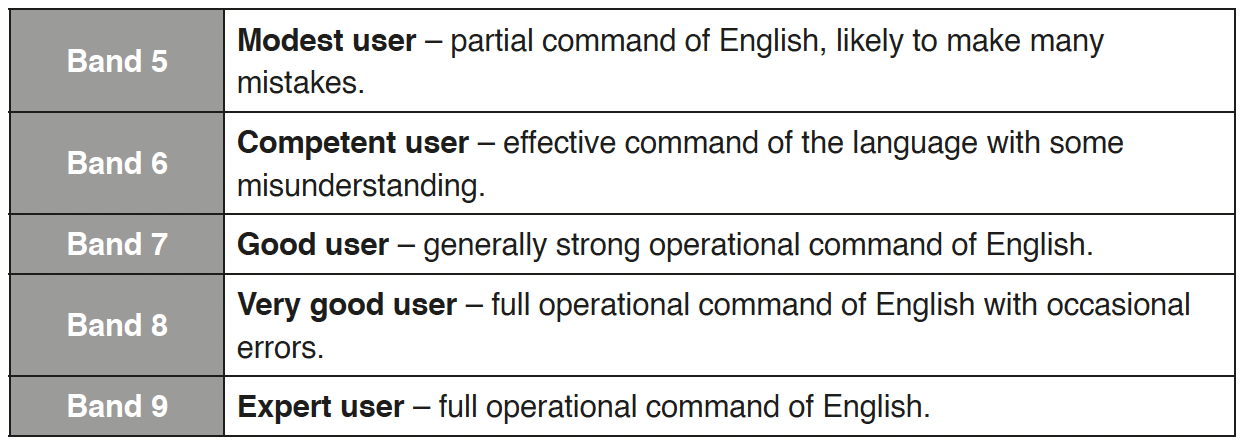
The scores are given in ‘bands’. The score range is from 0 to 9, and you can score half bands too (e.g. between a 5.0 and a 6.0 is 5.5). You will get a score for each part of the test and then an overall score. 0 is the lowest score and is given when a candidate does not attempt any answers. 9 is the highest score and equates with an expert or fluent user.
Generally, to get onto an undergraduate degree programme, candidates need to aim for 5.5 or 6.0. However, this will depend on the university and the subject. For master’s degrees or for visas for positions in areas such as nursing, test takers will be required to get a 7.0 or higher in all parts. Again, courses and universities differ in their entrance requirements, so you need to check this.
Band scores relate to the following levels of proficiency, from Band 5 upwards:
You are given a band score for each of the four sections. Your overall score is the rounded average of the four sections. For example:
Listening score: 6.5 Reading score: 7 Speaking score: 5.5 Writing score: 5.5
Average score: 6.125
Overall band score: 6
Detailed information about the IELTS test format and scoring system can be found online at www.ielts.org.
The most important thing to understand about the scores is what you need and what you need to do to get that score.
Some reasoning behind the examination
There are many reasons why the examination is designed as it is. Firstly, there are reasons of practicality and reliability. There are lots of test takers in many different parts of the world, so the test needs to be delivered in different contexts, yet the results need to be meaningful. In terms of the Reading and Listening papers, having question papers with set answers means that there is little deviation between individuals (just right or wrong answers), and everyone is being assessed in the same way.
The examination makes efforts to be as fair as possible for all test takers. This means that sometimes the readings are on unusual subjects, but this is better than focusing on more familiar subjects that some candidates might know but others are not familiar with. For example, imagine if a reading text was about pop music in China. A lot of test takers from China might be able to answer the questions more easily because they are probably more familiar with the subject. This is exactly why subjects are chosen to be accessible, but not focus on existing knowledge of candidates.
The examination also tests the skills that are needed at university. We will look more indepth at what each part of the test is testing in later sections, but for now let’s look at this in general. The Reading test requires you to process and understand details in quite long texts in a short amount of time. This is something you’re likely to do at university. There you will have a lot to read, and you’ll need to read effectively and understand key points. In terms of the Writing test, the sections are quite different, but this is an indication that you can write both factually and deal with data that may appear in reports as well as present an argument, which is commonly required when writing essays.
How well will I do?
This depends on your level of English but also how familiar you are with the examination. However, there is one important thing to remember: there is no way to ‘beat’ the test. Knowing the format helps, but you need vocabulary, grammar and the skills of reading, writing, listening and speaking at the appropriate level.
There will be parts of each paper that you are better at, and parts that you find more difficult. As previously mentioned, often for first language English speakers, the Reading test is the most difficult. For people whose first language isn’t English, the parts you are good at may vary. Often, candidates can get the scores they require in Reading and Listening, but not in Writing and Speaking.
-
Probably the most important question here is: how do you know what parts you need to improve and how can you improve them?
Firstly, do a practice test. There are tests on the official IELTS website.
Check your answers and your scores, and you will realise the areas in which you may require additional preparation. However, with your Writing and Speaking practice, ask someone who has a higher level of English than you to check your performance because this is impossible for a book to assess adequately.
Once you have an idea of your performance in each part, you can start practising to improve the skills you need. For example, if Listening is your weakest skill, you might want to focus more on this area by listening to English radio programmes or online lectures (possibly with subtitles), or by buying a preparation book that focuses on this skill.
How to use the book

A resource for advanced speakers of English and first-language English speakers who wish to take the IELTS Academic test and want to find out more about what the exam entails.
The book is separated into five main chapters: the first section gives an overview of the exam, and the subsequent chapters look at each part of the test. The second chapter focuses on the Listening test, the third the Speaking test, the fourth the Reading test, and then, lastly, the Writing test. You do not have to read the chapters in order if you do not want to. Each chapter contains test information and exam tips. You also have an option to practise the question and task types.
Have you seen our new platform for English exam practice?


Our AI-powered grading provides comprehensive feedback on Writing submissions…

Try it out for free: