An in-depth look at collocations | B2–C1
If you’ve been studying English even for a short period of time, you’ve probably already come across a considerable number of collocations. Perhaps you encountered some the last time you sat for an exam. Are you confident that you’re learning them correctly? Or do they make you hopelessly confused? Is it hard for you to make time to really learn them? Well, this user-friendly book by David Bohlke takes an in-depth look at collocations.
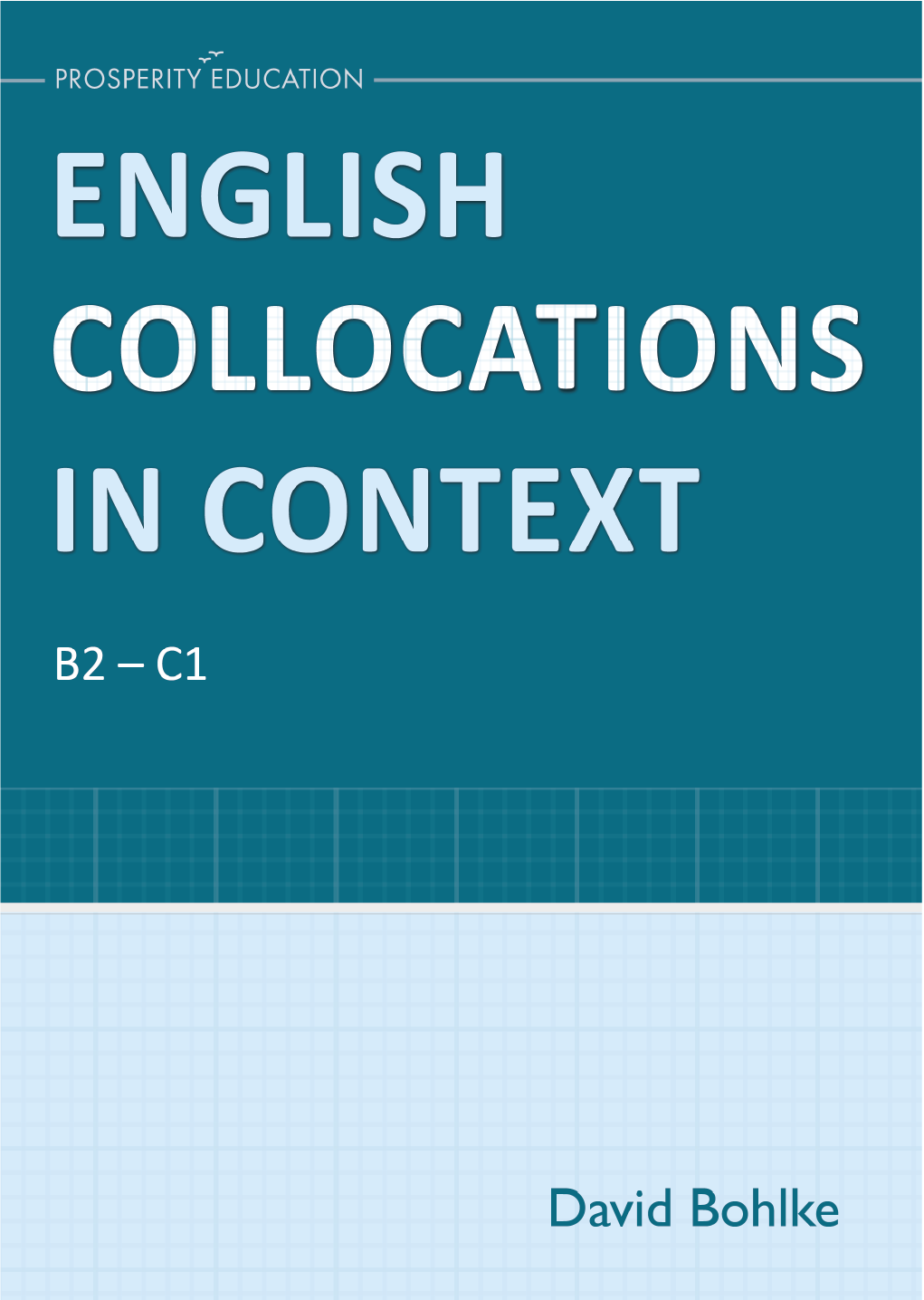
Key features:
40 units on everyday topics commonly found in coursebooks
600 collocations practised in context
80 contextualised collocation exercises with answers
120 speaking and writing prompts
Index of 2,200+ collocations
David Bohlke is an ELT author, editor, trainer and consultant who has commissioned, edited and written some of the world’s top-selling courses and skills texts for the adult, secondary and academic English markets, including: Four Corners and Final Draft (Cambridge University Press); Skillful (MacmillanEducation); Next Generation Grammar (Pearson); and Speak Now (Oxford University Press).
What are collocations?
Collocations are groups of two or more words that tend to be used together. They are common in English and sound ‘right’ to native speakers. Examples include heavy rain, make a decision and wildly optimistic. If a speaker instead says large rain, do a decision and excitedly optimistic, the listener will likely understand the gist of what’s been said, but the phrases will sound strange – even wrong. A native speaker would never combine words in this way.
Why are they so difficult to understand?
There is not always a grammatical reason why some words go together in English while others do not. That is what makes learning and remembering collocations a challenge. There is often not a clear reason why a native speaker says fast food, for example, but not quick food.
Another reason why learning collocations can be a challenge is that many words in English have several collocations. For example, the word friend(s) can be used in true friend, trusted friend, long-lost friend, circle of friends, make friends, meet through friends, send a friend request and in many other ways too.
Why learn collocations?
When you learn collocations your language will sound more natural, and you will be more easily understood. Using collocations correctly will help to show others your true level of English. And if you know a lot of collocations, you will also have multiple ways of expressing yourself!
In addition, a good knowledge of collocations will help you if you are preparing to take standardised exams like IELTS or TOEFL. Collocations are common in these types of exams. If you need to speak or write as part of an exam, your language will sound much more natural if you use collocations correctly.
Types of collocations
There are many types of collocations. Some of the most common types are:
-
I think he’s painfully shy.
I’ve been incredibly busy lately.
My classmates are exceptionally friendly.
-
The father is often the main breadwinner.
What I’m offering has a competitive advantage.
A common thread in her work is the use of colour.
-
I have brand loyalty for certain things.
I’d start by thinking about your target audience.
A community family is not made up of blood relatives.
-
At night we might do a puzzle.
They often slash prices on big-ticket items.
Don't feel pressured to declare a major right away.
-
I don’t think he dresses appropriately.
She works tirelessly during the week.
Look, I control it remotely.
-
The house is in the suburbs.
Make sure you are on time.
That style of dress is in fashion.
-
She’s low on cash.
I’m not active on social media.
I’ve been eating a lot of food that is high in fat lately.
How to learn collocations
When you come across a new collocation, think of it as a ‘chunk’ of language. It’s easier for our brains to remember and use language in chunks rather than as single words.
Here are some other tips that may be helpful in learning collocations:
Read a lot. It’s an excellent way to see collocations in context.
Try to recognise collocations when you see or hear them.
Use coloured highlighter pens to mark different types of collocations.
Write down other words that collocate with the new collocation.
Practise using new collocations soon after learning them.
Will this book help?
This book can be used as a classroom text, but it’s primarily a book for self-study. It contains 40 units on everyday topics commonly found in coursebooks. In the odd-numbered units, the collocations are presented through two dialogues. In the even-numbered units, the collocations are presented through a variety of texts.

Download a free sample
Each unit presents approximately 15 collocations in context. Try to learn each whole collocation, but pay attention to the individual words. After you have read and understood the dialogues/texts, move onto the two self-check exercises. Refer back to the collocations in the dialogues/texts as needed. Once you have completed the self-checks, check the Answer key at the back of the book.
Remember, practice makes perfect…
Good luck with your studies :)